MENU
Mental Health and the Stories We Inherited
A different story asks different questions.
This newsletter was supposed to go out in May, during Mental Health Awareness Month. It is now June.
One story says we missed the mark. We were late. We failed to execute. We should have pushed harder, planned better, gotten it done. Another story asks different questions.
What was May asking of us? What were we carrying? What did care require? What would it mean to honor both accountability and capacity? What choice would reflect the world we say we are trying to build?
We still care about timelines. We still care about doing what we said we would do. Part of accountability is being honest when the plan needs to change. So we made a choice. We pushed this newsletter back to create more space to care for ourselves and others. That is not an excuse. It is the point.
The stories we use to understand a moment shape what we believe is possible inside that moment. And mental health is full of inherited stories.
Mental health is never just an individual story.
Mental health lives in bodies, yes. It also lives in families, workplaces, neighborhoods, schools, calendars, budgets, policies, histories, and relationships. It lives in what we are taught to call strength, what we are taught to hide, and what we are allowed to need.
That is the big idea underneath this piece: the way we understand mental health shapes what we build around it. If we understand struggle mostly as weakness, we build shame. If we understand mental health mostly as an individual maintenance issue, we build more tools for individuals to keep functioning. If we understand mental health as connected to conditions, culture, history, relationship, and belonging, the work gets bigger. It also gets more honest.
Systems are built from the stories we keep repeating.
At BetterWorld Partners, we talk a lot about systems change. And I will be honest: systems change can sometimes feel like trying to nail Jell-O to a wall. The words get big very quickly. Culture. Equity. Transformation. Liberation. Belonging. Healing. All true. All important. Also, sometimes, hard to grab onto.
But there is a there there.
Systems are made of things we can name: policies, practices, money, relationships, power, and mental models. They are made of what we reward, what we punish, what we measure, what we ignore, who gets believed, who gets protected, and what we keep calling “normal.” 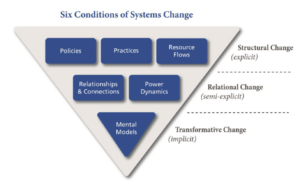 That is one reason we appreciate FSG’s Water of Systems Change framework. It gives us a way to see the conditions that hold systems in place: the visible ones, like policies and resources, and the less visible ones, like relationships, power dynamics, and mental models.
Mental models are the stories underneath the strategy.
When FSG talks about mental models, they are talking about the values, assumptions, and beliefs underneath how we understand an issue. A mental model is the story we are using, often without realizing it. It is what we believe is true, normal, responsible, possible, or deserved.
So when we talk about mental health, it matters which story is running underneath the conversation.
From where we sit — in this country, in this moment, in these bodies, with our particular experiences of work, family, gender, race, culture, class, care, and responsibility — the dominant story still carries a lot of individualism.
Handle it.
Push through.
Be grateful.
Try harder.
Don’t need so much.
Keep functioning.
If you were stronger, more disciplined, more faithful, more resilient, more whatever, you would be fine.
That story has done real damage. And once that story gets into the water, it starts designing things.
We build workplaces that reward overextension and call it commitment. We build schools that name behavior without asking enough questions about context. We build care systems that make people prove how much they are struggling before support becomes available. We build communities where people say “ask for help,” but quietly judge the asking. That is what mental models do. They become policies, practices, budgets, expectations, habits, and norms. They become the system.
Older ways of knowing remind us we belong to each other.
There is something important happening in the mental health conversation right now. We are beginning to move, at least in some places, out of the story that says mental health is mostly about individual grit, discipline, and private coping.
When we say, out loud, that mental health is connected to trauma, stress, isolation, racism, caregiving, housing, work, money, food, water, safety, culture, history, land, and belonging — that matters. That is not nothing. That is a crack in the old story. And it is also not some brand-new discovery.
We can see this in many Indigenous and ancestral frameworks of wellbeing, where health has long been understood through relationship — to family, community, land, spirit, ancestors, culture, story, body, and place. I do not want to flatten those traditions or pretend they are all the same. I do want to notice how narrow the dominant American frame has become.
So maybe part of the work is not inventing a whole new way to think about mental health. Maybe part of the work is repairing our connection to ways of knowing we were taught to dismiss.
Interdependence is already true. Living like it is true takes practice.
We are in a contest of ideas. Always.
One story says we are separate. My wellbeing is mine, your wellbeing is yours, and the best we can do is protect what belongs to us.
At BetterWorld Partners, we believe a different story: we are interconnected and interdependent. What happens to you is not separate from what happens to me. The health of our bodies is tied to the health of our relationships, our communities, our food systems, our water, our work, our histories, and our imaginations.
If we actually believed that — not as a slogan, but in our bodies — everything would have to change.
How we design work would change. How we think about healthcare would change. How we respond to crisis would change. How we measure success would change. How we practice responsibility would change. The story we tell about mental health determines what we believe is ours to carry together. I am not talking about carrying everyone and everything until we collapse. We have plenty of that already.
I am talking about telling the truth: individual success is downstream from community conditions. If the people around me are hungry, unsafe, isolated, sick, overworked, underpaid, or afraid, that shapes what is possible for me too. Maybe not immediately. Maybe not in the same way. But eventually.
Interdependence is not a theory. It is the condition we are already living inside. The practice is learning to act like we know that. This is one reason Mia Birdsong’s How We Show Up belongs in this newsletter. The book asks us to take community, belonging, and mutual care seriously — not as a slogan, but as something we practice in ordinary life.
That same question runs through this whole conversation: are we separate, or are we responsible to and with one another?
A different story asks different questions.
If we choose the second story, we start asking different questions.
How do we help people cope? Yes.
And: what are we asking people to survive?
Why didn’t this person ask for help? Yes.
And: what made asking feel unsafe, shameful, or impossible?
How do we build resilience? Yes.
And: what are we calling resilience that is actually endurance under harm?
Did we meet the deadline? Yes.
And: what did it cost, and did the way we worked reflect the world we say we are building?
I am all for a walk and a glass of water. I am not for pretending a walk and a glass of water can fix precarity, isolation, racism, violence, debt, overwork, or despair.
D.I.V.E. helps us pause before the old story takes over.
This is where this month’s Tool Time, D.I.V.E., is useful.
D.I.V.E. gives us a way to slow down, check what we actually know, and notice when we have moved from observation into interpretation or judgment. We hope you’ll check it out as a practical tool for asking: What story am I using right now? What have I not checked? What might become possible if I paused before deciding?
Healing begins when we can examine the story without shame.
At BetterWorld Partners, we are practicing toward a world rooted in interconnectedness and interdependence.
That world is not abstract. It would change what care looks like before crisis. It would change who gets believed. It would change what work asks of people. It would change how communities respond to grief, conflict, disability, distress, and need. It would change what we measure, what we fund, what we punish, and what we call normal.
We are not there yet.
And by “we,” I mean the broader we: those of us living inside systems shaped by individualism, urgency, perfectionism, scarcity, and shame. BetterWorld is not outside of that. None of us are. We are shaped by the same water we are trying to understand.
One of the reasons we are not there yet is that we often want change without changing anything. We want more equitable outcomes — meaning we want access, dignity, safety, belonging, power, and wellbeing to be more real for more people, especially the people who have been pushed furthest from them.
But equitable outcomes do not come from better intentions pasted onto the same assumptions. They require us to notice the habits of thought underneath our strategies: what we believe people deserve, who we think is responsible, what pace we treat as normal, what kind of excellence we reward, and whose needs we are willing to organize around.
And don’t get it twisted, sister: individual responsibility matters. It does. Urgency is real sometimes. Wanting to do a good job is not the problem. The problem happens when individual responsibility becomes separation. When urgency becomes the permanent pace. When doing a good job becomes perfectionism, and perfectionism becomes the price of belonging.
Those stories cannot carry us where we say we want to go.
If we want something we have never had, we will have to do something we have never done. We started this piece with a newsletter that did not go out when we planned. That is a small thing. It is also a real thing. Because the old story is always available: push through, explain less, perform capacity, keep moving. We are trying to practice a different story. One where accountability includes honesty. One where care is not treated as the opposite of responsibility. One where timing matters and people matter.
That is the work of mental models: noticing the inherited story before it runs the room.
Maybe healing begins there — when we can examine the stories underneath our responses without shame, check them against what we value, and choose the next practice from there. So here is the invitation: this week, notice one story you are using. About mental health. About responsibility. About rest. About asking for help. About what makes someone worthy of care.
Notice where it came from. Check it against what you value.
See what shifts.
Published June 22, 2026