
MENU
Tool Time #1 — Truth. Space. Action.
When hard things happen, leaders often ask a familiar question:
What do I say — internally and externally — without making things worse?
One simple framework we return to is Truth. Space. Action., created by our colleagues at Team Dynamics. It was originally shared in 2020 as a way to help leaders respond during moments of shock, grief, and collective harm—when silence feels wrong, but certainty is hard to come by.
This isn’t a script.
It’s not a checklist.
It’s a way to orient yourself when your nervous system is activated and clarity feels out of reach.
Rather than pointing to another organization as an example, we want to share how we practiced this ourselves at BetterWorld Partners—not as a model of “getting it right,” but as a real example of what practice can look like.
How We Practiced Truth. Space. Action. at BetterWorld Partners
On the morning of January 7, we were in a staff meeting when we learned a DHS Agent had killed Minneapolis resident Renee Good.
Like many moments like this, it arrived suddenly, with limited information and a lot of emotion.
Truth (Internal and External)

Internally, the first truth we named was simple:
Something awful has happened, and we are tender.
We didn’t try to interpret it.
We didn’t rush to meaning-making.
We named what was real for us in that moment.
Externally, we chose to name that truth publicly as well. In a post we shared that morning (January 7 Facebook post), we acknowledged what had happened, named our grief and shock, and spoke honestly about how it was affecting us as people and as an organization.
We didn’t try to resolve the moment or explain it away. We simply named reality and impact.
Truth, in moments like this, is not analysis or positioning. It’s refusing to pretend nothing happened.
Space (Primarily Internal)
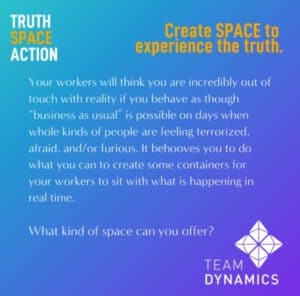 After that staff meeting, I said something like this to our team:
“Go do the work your nervous system needs you to do right now.
If your head and your heart need you to be in community, go there.
If your head and your heart need the consistency or stability of this office, please stay.
This is a choose-your-own-adventure moment.”
That choice was the space.
Some people left to be in community.
Some stayed in the office.
Some moved between the two.
For the first week, we didn’t see much of each other—because people were being called into different kinds of work: community work, family work, personal work.
The second week, we gathered a little more.
By the third week, we were together more consistently—but even then, our staff meetings were less about productivity and more about triage.
What actually needs to get done right now?
What can wait?
How do we hold our organizational responsibilities alongside the community, family, and interpersonal work each of us is being called to do?
That, too, was space.
Action (Where Values Become Lived)

Action is the part of this framework that often gets misunderstood.
Action is not:
- saying what everyone else is saying
- issuing a statement without changing behavior
- listing commitments that aren’t connected to the moment
For us, action meant letting our values guide how we worked, not just what we said.
At BetterWorld Partners, we hold values like:
- honoring how people show up
- prioritizing care for ourselves and others
- progress over perfection
- trusting experience and intuition as valid ways of knowing
In this moment, action looked like:
- allowing flexibility instead of enforcing normal rhythms
- slowing work where possible and naming limits honestly
- checking in repeatedly, not just once
- letting care—not optics—guide our decisions
Importantly, this wasn’t a one-day response.
Action unfolded over time—through how we scheduled, how we gathered, how we prioritized, and how we showed up for one another.
Using This Framework Externally
Truth. Space. Action. can—and often should—be used externally as well.
The same principle applies:
If you tell the truth publicly,
and you create space internally,
and you say what you’re going to do—
you have to come back and say what you did.
Otherwise, values become language instead of practice.
This framework helps you think through what to say.
It does not finish the work for you.
A Note on Context and Practice
As we share this tool, it feels important to name the context we’re in right now.
Here in Minnesota, the presence of federal DHS, ICE, and Homeland Security agents continues. From where I stand, it feels like an occupation of the Twin Cities—and that is how I am experiencing it. I know others may name it differently, but this is my truth.
It’s also a reminder that there is almost always something happening in the world—locally or globally—that calls for thoughtfulness, response, or space. That’s not new. What’s hard is figuring out how to show up when those moments arrive.
Truth. Space. Action. is intentionally simple so it can be adapted:
- interpersonally
- with a team
- across an organization
- internally or externally
The goal isn’t agreement. The goal is structure—especially when your nervous system has taken over, your thoughts feel disorganized, or you’re afraid of saying the wrong thing and making things worse.
This framework gives you a way to slow down just enough to ask:
- What is true for me right now?
- What space is needed?
- What action would help my impact match my intention?
That alignment doesn’t happen automatically.
It takes practice. And like any practice, it’s imperfect, evolving, and shaped by the moment you’re in.
That’s the work.
Published February 11, 2026