
MENU
Faith and Belonging
Faith and Belonging
Lately, I’ve been sitting with a growing frustration.
It shows up in conversations—in the subtle ways people talk about faith, or avoid it altogether. I hear it in the assumption that to be a person of faith, especially a Christian, is to align with a particular political ideology. I feel it when empathy is dismissed as weakness, or worse, as something dangerous. I notice it when people committed to justice and belonging grow wary at the mention of organized religion.
We are living in a time when faith is increasingly used to divide. Religious language is invoked to justify exclusion, and political leaders claim moral authority while advancing policies that harm the most vulnerable. I felt this tension recently at a neighborhood gathering I co-hosted with a multi-faith organization working toward a more just future—where even naming “faith” seemed to shift the air in the room, making belonging feel more fragile.
There seems to be a narrowing of what it means to be Christian, as if it can be reduced to a single stance or allegiance.
And it troubles me.
Because the faith that shaped me tells a very different story.
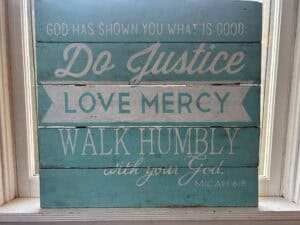
I was raised Roman Catholic in a college town where my parents taught. We attended the campus Newman Center—an unconventional, creative “hippie church” with guitars, liturgical dancers, and flexible space.
Church wasn’t rigid. It was alive, participatory, rooted in community.
At the same time, I attended a more traditional Catholic school, where rituals were formal and structured.
These two experiences taught me early on that faith could hold both tradition and creativity.
It could hold complexity. It didn’t have to be one thing.
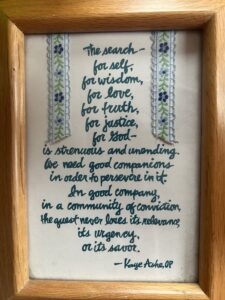 That understanding deepened when I joined the Apostolic Volunteer program and moved to Chicago, where I lived in an intentional community connecting Little Village and North Lawndale in a deeply segregated city.
Living between two very different communities made visible what I had been learning all along: that faith calls us toward one another, especially across the lines that society uses to divide us.
From those experiences, and from Catholic Social Teaching, I came to understand something that continues to shape my work today: human dignity is not something we earn. It is something we all carry, across race, culture, ability, and belief.
Difference is not a problem to solve.
It is part of the sacred.
So when I hear empathy described as “woke” or incompatible with Christianity, I feel a kind of dissonance—not because I’m confused, but because I know another way of understanding faith. One that sees empathy as essential, rooted in relationship, and oriented toward those who have been marginalized.
This is the faith that continues to shape my work.
Today, I work as a coach and facilitator, helping individuals and teams engage across difference with greater awareness and care.
People sometimes assume my commitment to equity exists in spite of my faith.
For me, it is because of it.
And I know this story of faith is not mine alone.
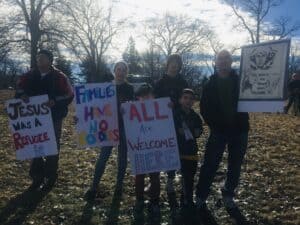
I think of Dorothy Day and Martin Luther King Jr., of Oscar Romero, and the countless unnamed leaders who have grounded their work for justice in faith. I think of people in my own community who show up, quietly and persistently, guided by a belief in something larger than themselves.
This version of faith rarely makes headlines.
But it is there.
In choices to stay in relationship. In acts of accompaniment. In the slow, often unseen work of building a more just world.
I return to this: our identities do not have to be in competition.
We are taught to think in binaries—to believe that if we are one thing, we cannot be another. That faith and justice sit on opposite sides. That belonging must come at the cost of conviction.
But what if that’s not true?
What if our identities are not subtractive?
What if they are additive?
My Catholic faith is not something I set aside to do this work, but something that calls me more deeply into it.
I believe that faith, at its best, expands our capacity to see one another as fully human.
I don’t have easy answers to the polarization we are living through. But I do know this:
The Gospel I was formed in is one of liberation.
And in a time when it feels easier to pull apart, I find myself moving in the opposite direction.
Toward relationship.
Toward curiosity.
Toward a deeper, more expansive understanding of what it means to belong.
Published March 24, 2026
