
MENU
Tool Time #3: Transparency, Reciprocity, Inquiry (TRI)
When you want to ask a hard question, but don’t want to cause harm, what do you do?
In our work, our communities, and our close relationships, we often find ourselves needing to ask questions that sit outside our own experience, values, or frame of reference—sometimes in the context of power differences.
We know curiosity matters. It’s foundational to intercultural awareness and effective leadership.
And.
We also know that questions don’t always land the way we intend. Even well-meaning curiosity can create tension, defensiveness, or harm.
So we hesitate.
We stay silent and move forward without understanding.
We ask, but feel unsure how it landed.
Or we push through quickly, hoping for the best.
TRI is a tool for these moments.
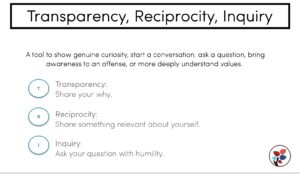
TRI is a simple framework for asking questions with care, clarity, and accountability—so you can build trust and better understand someone’s perspective.
We were first introduced to this tool in the Facilitating Cultural Change workshop, and it’s one we’ve returned to often in our facilitation and leadership work.
Transparency: Share your why
Start by naming why you’re asking.
What’s behind your question? What are you hoping to understand? What assumptions or reactions might you be holding?
This matters because questions without context can feel loaded.
Most of us have had the experience of being asked something and thinking:
Where is this going? What’s the real question here?
Transparency reduces that guesswork.
It signals intention. It builds trust. It lets the other person know you’re not setting a trap—you’re opening a conversation.
T: “I care about being a good neighbor, and I’ve been thinking about my own assumptions and how I understand what’s been happening in our community.”
Reciprocity: Share something of yourself
Before asking someone to share, offer something of your own experience, perspective, or uncertainty.
This is often the step that feels most uncomfortable, especially for those of us navigating dominant culture identities. Many people have learned not to center themselves, and that awareness is important.
Reciprocity isn’t about centering yourself—it’s about balancing the exchange.
Without it, curiosity can become extractive:
I want to understand you, so tell me.
Reciprocity shifts that dynamic:
I’m willing to share something of myself as I ask something of you.
It communicates:
We’re both in this conversation together.
R: “When I see the sign in your yard, I notice I’m making assumptions about what it represents, and I realize I don’t know much about how others are experiencing what’s been happening in the Twin Cities.”
Inquiry: Ask with humility
Then, ask your question.
Simple. Clear. Grounded in humility.
Humility matters because it lowers defensiveness and invites honesty. It acknowledges that you may not fully understand, and that you’re open to learning.
I. “Would you be open to sharing how you see what’s been happening with Operation Metro Surge?”
In moments like this, when we’re in relationships where we don’t hold authority—like with neighbors, acquaintances, or people we don’t know well—there is always the possibility the person may not want to engage.
And that’s okay.
This tool invites conversation. It doesn’t guarantee it.
How We Practice It
Like any tool, TRI can feel a little awkward at first.
That’s normal.
We often encourage people to practice in lower-stakes relationships first—friends, family, colleagues you trust—so it becomes more natural over time.
You will make mistakes.
When you do, own them. Repair where needed. Keep going.
That’s the practice.
Example In the Workplace
Transparency:
“I want to check in about how our deadlines have been landing, because I’ve noticed some have been harder to meet.”
Reciprocity:
“I know I’ve had to adjust my own expectations and pacing recently with everything going on.”
Inquiry:
“What’s been coming up on your end, and what do you need right now to get back on track?”
In workplace settings, TRI can be especially helpful because it supports direct communication while still centering care and relationship.
It creates space for accountability and understanding.
A Note on Communication Styles
TRI leans toward direct communication, which is often the dominant norm in many workplace cultures.
For people who tend toward indirect communication, this tool can help build confidence in being more explicit and clear.
At the same time, when using TRI with someone who prefers indirect communication, the directness of the question may feel abrupt or uncomfortable.
That doesn’t mean the tool isn’t working—it means you may need to adjust. Slow down, soften your delivery, or spend more time in Transparency and Reciprocity before moving to Inquiry.
As always, context matters.
Try It Yourself
Think about a conversation you’ve been avoiding—or one where you want more understanding but aren’t sure how to begin.
Before you ask the question, pause and consider:
- Why am I asking this?
- What can I share about my own perspective or uncertainty?
- How can I ask this in a way that invites, rather than pressures, a response?
Sometimes the difference between harm and connection isn’t whether we ask—it’s how we ask.
TRI gives you a way to move forward with intention.
And like any practice, it gets stronger the more you use it.
Published April 18, 2026
